
How to Stop Leash Pulling: A Step-by-Step Loose-Leash Walking Plan
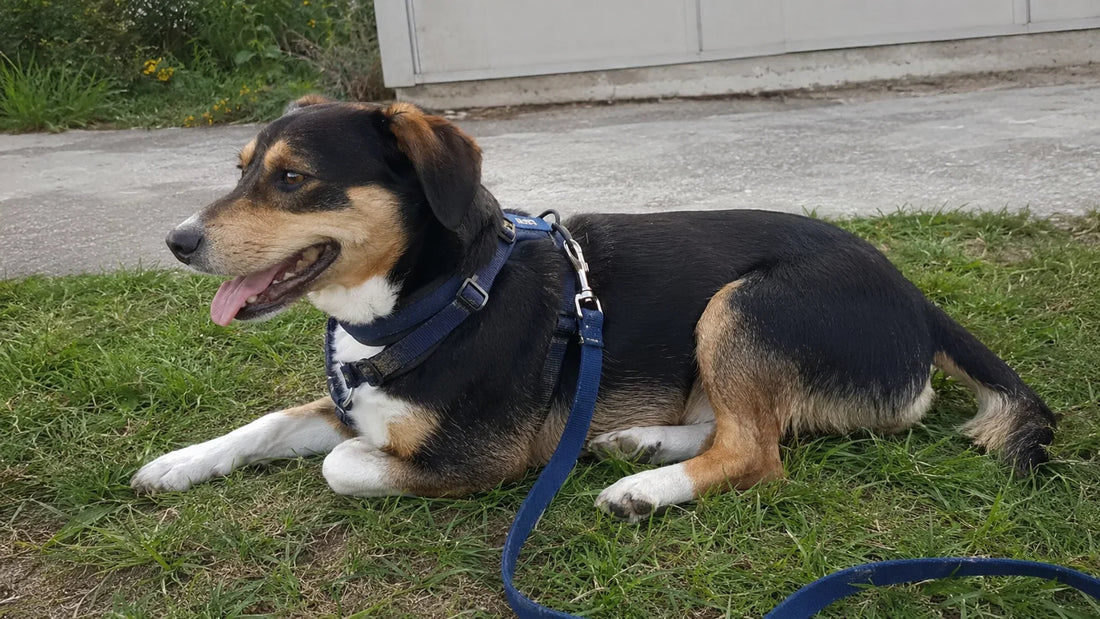
A dog who pulls is not necessarily being stubborn. In many cases, pulling has simply worked. The dog leans toward a smell, person, patch of grass, or destination, and the walk continues in that direction. Each successful step can make pulling more likely the next time. Dogs may also move faster than people, become highly excited outdoors, or struggle to think clearly around distractions.[2] [4]
Loose-leash walking changes that pattern. The dog learns that a slack leash keeps the walk moving and opens access to rewards, while a tight leash pauses forward progress. Food, praise, movement, and permission to sniff can all reinforce the behavior you want. Veterinary behavior guidance recommends reward-based training and advises against methods that rely on pain, fear, intimidation, or physical corrections.[1]
The plan below starts in an easy setting, builds the skill in small pieces, and then adds real-world distractions. Some dogs improve quickly, but reliable loose-leash walking often takes weeks or months of regular practice. Progress depends on the dog's history, age, health, arousal level, environment, and the handler's consistency.[2]
What Loose-Leash Walking Means
Loose-leash walking is not the same as a formal heel. A dog does not need to keep one shoulder aligned with your leg for the entire walk. The practical goal is simpler:
- The leash hangs in a relaxed curve instead of staying tight.
- The dog can walk, pause, and sniff without dragging the handler.
- The handler can change direction or pace without a struggle.
- Both dog and handler remain physically safe.
You may choose a preferred walking side for narrow sidewalks or crowded areas, but the most important rule is leash tension. Slack allows the activity to continue. Tension pauses it.
Why Dogs Pull on the Leash
Pulling can have more than one cause. Identifying the main cause helps you choose the right starting point.
- Pulling has been rewarded: The dog has repeatedly reached interesting places while the leash was tight.
- The environment is more rewarding than the handler: Smells, animals, people, movement, and familiar destinations can compete with food or praise.
- The dog is moving at a different pace: Many dogs naturally travel faster than a person walking at a steady pace.
- The dog is overexcited: The leash, front door, car, or sight of the usual route may trigger intense anticipation.
- The dog is worried or frustrated: Pulling, freezing, barking, or lunging can be related to fear, frustration, or a strong urge to chase.
- The skill has not been generalized: A dog may walk well in the kitchen but not yet understand the same rule on a busy sidewalk.
Ordinary pulling and leash reactivity are not always the same problem. A dog who barks, growls, lunges, spins, redirects onto the leash, or tries to chase traffic may need an individualized behavior plan rather than a basic walking lesson.[2]
Choose Safe, Comfortable Equipment
Equipment can improve safety and make training easier, but equipment alone does not teach loose-leash walking. The lesson still comes from consistent consequences and well-timed rewards.[5]
A well-fitted harness
For many dogs, a well-fitted H-style or Y-style harness is a practical choice. Look for a design that:
- Does not rub behind the front legs or press into the neck.
- Allows the shoulder joints to move freely.
- Cannot be backed out of when the dog reverses.
- Has secure hardware appropriate for the dog's size and strength.
- Offers a back attachment, a front attachment, or both.
A front attachment may give the handler more steering control, but it is a management aid, not a cure. Avoid harnesses with straps that sit directly across the front of the shoulder or alter normal movement. Check the fit regularly, especially in growing puppies and dogs whose weight or coat changes.[2]
A fixed-length leash
A six-foot fixed-length leash works well for most everyday training. In open, low-risk areas, a leash up to about ten feet can provide more room to sniff while still allowing clear communication. Choose a leash that is comfortable to hold and strong enough for the dog. Do not wrap it around your fingers or hand.
A fixed-length leash is usually easier for teaching a consistent slack-leash rule. VCA also advises against retractable leashes because they can cause serious friction burns.[2]
Rewards and a marker
Bring small, easy-to-eat treats that your dog values. Soft treats are often easier to deliver while moving than large biscuits. You can also use part of the dog's regular food when it is motivating enough. Account for training food in the dog's daily intake, and ask your veterinarian about suitable rewards if your dog has allergies, digestive disease, a prescription diet, or another medical restriction.
Choose a brief marker such as "yes", or use a clicker if your dog is comfortable with the sound. The marker identifies the exact moment the leash is loose or the dog makes a useful choice. The reward follows immediately afterward.
Equipment to avoid
Do not use leash jerks or collars designed to tighten, pinch, shock, or cause pain when the dog pulls. The American Veterinary Society of Animal Behavior recommends reward-based methods and specifically advises against choke chains, prong collars, electronic collars, and physical leash corrections. Pain-based methods can harm welfare and may increase fear, anxiety, avoidance, or fear-related aggression.[1]
If your dog is strong enough to pull you over, do not rely on force or buy a harsher tool. Move training to a safer location and get in-person guidance. A qualified professional may recommend a carefully fitted front-attachment harness or a gradually conditioned head collar. A head collar requires slow introduction, a backup connection to a harness or collar, and gentle handling. It must never be used for leash jerks.[2] [5]
Set Up the Training Before You Start Walking
Loose-leash training is easier when the dog is able to learn. Before each session:
- Give the dog a chance to toilet.
- Start in a quiet room, hallway, yard, driveway, or empty parking area.
- Train one dog at a time.
- Use short sessions, often three to five minutes at first.
- Keep treats where you can reach them without stopping.
- Choose a walking cue, such as "let's go".
- Choose a release cue, such as "go sniff".
Do not make every outing one long obedience exercise. Dogs also need safe opportunities to sniff, explore, play, and move at a comfortable pace. Meeting those needs separately can make focused leash practice more manageable.[2]
Step-by-Step Loose-Leash Walking Plan
-
Step 1: Teach the marker
Begin without walking. In a quiet room, say your marker word once and immediately give a treat. Repeat several times until the dog clearly expects food after hearing the marker.
Next, wait quietly. When the dog looks toward you, mark and reward. You are not testing obedience. You are teaching the dog that paying attention to you produces useful information and rewards.
-
Step 2: Reward the walking zone
Stand with your dog near the side where you plan to deliver treats. The moment the dog stands beside you or moves into easy reach, mark and feed at the seam of your pants. Feeding beside your leg matters. If you repeatedly deliver food out in front, you may accidentally encourage the dog to surge ahead.
Take a small step away. When the dog follows into position, mark and reward again. Practice from both stationary and moving starts. Keep your body relaxed and avoid pulling the dog into place.
-
Step 3: Add one to three steps
Say "let's go", take one step, mark while the dog is still close, and feed beside your leg. Repeat until one step is easy. Then try two steps, three steps, and several steps.
At the beginning, rewards may come every one or two steps. That high rate is not permanent. It gives the dog enough successful repetitions to understand the new pattern. VCA's loose-leash protocol likewise begins with very short movement and frequent reinforcement.[2]
If the dog jumps at the treat hand, keep the hand closed, wait for four paws on the ground, then mark and deliver calmly. If the dog races ahead immediately after eating, give the next reward sooner and place it slightly behind the line of your leg.
-
Step 4: Add the leash in the same easy setting
Clip on the leash and stand still. Hold enough leash for safety, but leave a visible curve instead of shortening it into constant tension. Wait for any moment of slack, even a small one. Mark and feed near your foot or beside your leg. Take one or two steps and repeat.
Keep your hands steady and your elbows relaxed. A constantly tight leash makes it difficult for the dog to tell when the correct behavior has occurred. Your goal is to create a clear contrast between slack and tension.
-
Step 5: Use the same response every time the leash tightens
This is the central rule of the plan:
- Stop moving as soon as the leash begins to tighten.
- Keep the leash steady. Do not jerk, reel the dog in, or pull backward.
- Wait for the dog to look back, turn toward you, or take a step that softens the leash.
- Mark the instant the leash becomes slack.
- Reward beside you, say "let's go", and continue.
If the dog remains fixed on the distraction, calmly take a few steps in the opposite direction. Reward the dog for following and reconnecting. RSPCA and Dogs Trust both recommend stopping forward movement when the leash tightens, then resuming after the dog returns attention or slackens the leash.[3] [4]
Stopping is not meant to frustrate the dog for a long period. It is brief feedback. If you are stopping every few seconds, the environment is probably too difficult or the reward rate is too low. Move somewhere quieter and shorten the exercise.
-
Step 6: Make sniffing part of the reward system
Food is useful because it can be delivered quickly, but it is not the only reward. Access to the environment is often more valuable. Use that motivation instead of fighting it.
When your dog walks several steps with a loose leash toward a safe patch of grass or another appropriate sniffing spot, say "go sniff" and allow time to investigate. If the leash tightens on the approach, stop. Resume when it softens. The dog learns that loose-leash walking makes access happen, while pulling delays it. RSPCA uses the same principle when teaching a dog to approach a desired object without pulling.[3]
Separate focused walking from free sniffing with clear cues. During a sniff break, the dog can use more of the leash as long as it remains reasonably loose and the area is safe.
-
Step 7: Add mild distractions at a workable distance
Choose one low-level distraction, such as a person far away, a stationary toy, or the edge of a quiet park. Start far enough away that your dog can notice it and still eat, turn toward you, and move with you.
Reward these useful choices:
- Looking at the distraction without surging.
- Looking back at you.
- Following a change of direction.
- Keeping the leash loose for one or two steps.
If the dog cannot disengage, increase the distance. Do not pull the dog closer and hope for improvement. VCA recommends moving farther from a distraction when the dog cannot reconnect, and Dogs Trust recommends returning to an easier stage when the dog is struggling.[2] [4]
-
Step 8: Build duration gradually
Once your dog can take several loose steps, increase only one part of the challenge at a time. You might add more steps, a slightly busier location, a longer session, or a closer distraction. Do not increase all of them at once.
Move from rewarding every few steps to rewarding after varied stretches of good walking. Keep paying well in difficult places. You can also replace some food rewards with permission to sniff, forward movement, praise, play, or access to a safe destination. Dogs Trust recommends beginning with frequent treats and reducing them gradually as the skill improves.[4]
-
Step 9: Practice in new places
Dogs do not automatically apply a skill everywhere. When you move from the house to the driveway, or from a quiet street to a park, lower your expectations. Return to short stretches, frequent rewards, and more distance from distractions.
Practice with different household members, but keep the rules consistent. Everyone should stop when the leash tightens and reward slack. If one person allows pulling to reach every destination, the behavior will remain worthwhile.
A Flexible Four-Week Practice Schedule
This schedule is a progression, not a deadline. Stay at any stage longer if needed. A dog with years of pulling practice, intense reactivity, limited mobility, or a highly stimulating environment may need a slower plan. VCA notes that dependable loose-leash walking can take several months of regular work.[2]
- Week 1: Indoor foundations. Practice the marker, attention, the walking zone, and one to five steps. Use several short sessions instead of one long session.
- Week 2: Quiet outdoor practice. Work in a yard, driveway, empty lot, or calm section of sidewalk. Alternate brief training blocks with sniff breaks.
- Week 3: Mild distractions. Add distant people, quiet dogs, parked vehicles, or a low-traffic park edge. Increase distance whenever the dog loses the ability to respond.
- Week 4 and beyond: Real routes. Practice on ordinary walks, but continue to reward well near difficult locations. Add duration slowly and return to easier conditions after setbacks.
Move to the next level when the dog succeeds on most repetitions across several short sessions. Do not move on just because a certain number of days has passed.
Teach an Emergency U-Turn
A practiced U-turn helps you leave an unexpected distraction without dragging the dog.
- Start indoors without a distraction.
- Say a cue such as "this way".
- Turn 180 degrees and move in the new direction.
- Mark and reward as the dog catches up.
- Repeat until the dog turns promptly after hearing the cue.
Use the cue before the leash is fully tight whenever possible. Outdoors, turn away from an approaching dog, bicycle, runner, or other trigger while you still have enough distance to move safely.
How to Use Treats Without Creating a Bribe
Visible food can be useful as a temporary lure during the first few repetitions, but the goal is to stop depending on it as a prompt. Once the dog understands the movement, keep the food out of sight and reach for it after the desired behavior.
Use this sequence:
- Give the walking cue.
- Wait for or prompt the loose-leash behavior.
- Mark the correct moment.
- Reach for the treat.
- Deliver it beside your leg.
As the dog improves, vary the number of steps between food rewards. Do not stop rewarding completely. Difficult environments, new routes, and major distractions still deserve strong reinforcement. Blue Cross emphasizes that food can provide a worthwhile incentive while a dog replaces a long-standing pulling habit.[5]
Common Mistakes That Keep Leash Pulling Going
Letting pulling work when you are in a hurry
If tight-leash walking reaches the car, park, daycare entrance, or favorite tree, the dog still has a reason to pull. On rushed days, choose a shorter route or a lower-distraction outing rather than attempting a training session you cannot follow through on.
Starting in a place that is too difficult
A busy trail, pet store, school pickup area, or crowded park may be far beyond a beginner's skill level. Build the behavior where the dog can succeed, then add complexity.
Waiting to reward until the dog makes a mistake
Stopping pulling is only half the lesson. The dog also needs frequent information about what is correct. Mark and reward while the leash is loose, especially before the dog reaches the end of it.
Holding the leash tight all the time
Constant tension removes the contrast between correct and incorrect leash pressure. Give enough slack for the leash to form a relaxed curve while maintaining safe control.
Delivering treats too far forward
Reward placement influences where the dog returns. Feed at your side, not at arm's length in front of you.
Increasing difficulty too quickly
Longer duration, closer distractions, faster movement, and new locations are separate challenges. Change one at a time.
Using the training walk as the dog's only outlet
A dog who has had no chance to explore may find precise walking especially difficult. Provide suitable opportunities for sniffing, play, enrichment, and exercise based on the dog's age and health.[2]
Correcting fear or overarousal
A leash jerk may interrupt behavior, but it does not teach the dog how to feel safe or what to do instead. Punitive methods can add stress and may worsen fear-related behavior.[1]
Troubleshooting Common Problems
My dog will not take treats outdoors
First, move to a quieter place or increase distance from the distraction. A dog who normally likes food but suddenly refuses it may be too excited, worried, or overwhelmed to learn. Use a more valuable reward, shorten the session, and return to an easier environment. Do not keep moving closer to the trigger.
My dog pulls hardest during the first few minutes
Train the departure routine separately. Pick up the leash, reward calm behavior, clip it on, and pause. Open the door only while the leash is loose. Outside, spend the first minute rewarding very frequently. A calm stand is enough. You do not need to demand a long sit.
My dog pulls toward every smell
Use sniffing as the reward. Ask for a few loose steps, then release the dog to investigate. Over time, ask for slightly longer stretches before the release. This makes the walk rewarding without allowing the dog to tow you from scent to scent.
My dog surges ahead after every treat
Deliver the treat beside or slightly behind your leg. Give the next reward sooner, before the dog has time to accelerate. You can also take one step, feed, pause, and then restart instead of feeding while moving quickly.
My dog stops and leans into the leash
Do not pull harder. Use your U-turn cue, step away at an angle, or encourage one small movement toward you. Mark and reward the first softening of the leash. If the dog appears frightened, painful, unusually tired, or reluctant to move, stop the session and investigate the cause.
My dog zigzags from side to side
Decide when free sniffing is allowed and when you need a predictable walking side. During focused walking, reward at the same side of your body. During a release, allow more exploration where it is safe. Clear context is easier to understand than trying to prevent all sniffing.
I walk more than one dog
Teach each dog separately first. Once both dogs can walk with a loose leash in an easy setting, practice together with another handler. Combining two untrained pullers usually makes timing, reward delivery, and safe leash handling much harder.
My dog pulls toward other dogs or people
Do not use greetings as the first training exercise. Begin at a distance where your dog can remain calm and respond. Reward looking and then turning back to you. If the dog barks, lunges, growls, or cannot recover, move away and seek individualized help. The motivation may be fear, frustration, excitement, or chase behavior, and the correct plan depends on the cause.[2]
How to Measure Progress
Do not judge the plan only by whether the walk looked perfect. Track smaller changes:
- How often the leash becomes tight during a five-minute period.
- How many loose steps the dog can take before a reward.
- How quickly the dog reconnects after noticing a distraction.
- Which locations allow success and which remain too difficult.
- Whether the dog can alternate calmly between walking and sniffing.
A simple log can reveal progress that is easy to miss from day to day. Record the location, session length, strongest distraction, best stretch of loose walking, and one adjustment for the next session.
When to Contact a Veterinarian or Behavior Professional
Arrange a veterinary assessment when pulling or resistance appears suddenly, or when it occurs with coughing, gagging, noisy breathing, lameness, stiffness, weakness, sensitivity to touch, reluctance to wear equipment, or another change in behavior. Medical problems and pain can cause or contribute to behavioral changes, so they should be considered before treating a new behavior as a training issue.[6]
Get professional help promptly if:
- The dog can pull you over or escape the equipment.
- The dog lunges at people, animals, vehicles, or bicycles.
- The dog growls, snaps, bites, or redirects onto the leash or handler.
- The dog shows panic, shutdown, or intense fear outdoors.
- You cannot create a safe training setup.
- Consistent practice in easy settings is not producing improvement.
For basic skills, look for a trainer who clearly explains reward-based methods and allows you to observe or understand the training process. For aggression, severe fear, or complex behavior, ask your veterinarian about referral to a board-certified veterinary behaviorist or another appropriately qualified behavior professional. Avoid anyone who recommends pain, intimidation, flooding, or physical force.[1]
A Simple Loose-Leash Walk Script
- At the door, wait for a moment of slack and mark it.
- Say "let's go" and reward the first few loose steps generously.
- When the leash tightens, stop without jerking.
- When the dog turns back or softens the leash, mark and reward.
- Resume walking.
- After a successful stretch, say "go sniff" and allow an appropriate sniff break.
- Use "this way" and turn away before an unexpected distraction becomes too difficult.
The rule should remain simple throughout training: a loose leash keeps good things available. A tight leash pauses access. Clear timing, valuable rewards, short practice sessions, and manageable environments are more effective than trying to overpower the dog.
Sources
- American Veterinary Society of Animal Behavior. Position Statement on Humane Dog Training. 2021. Accessed July 12, 2026.
- Feyrecilde M, Horwitz D, Landsberg G. VCA Animal Hospitals. Loose Leash Walking With Dogs. Accessed July 12, 2026.
- RSPCA. How to Train Your Dog to Walk Nicely on the Lead. Accessed July 12, 2026.
- Dogs Trust. How to Stop Your Dog Pulling on the Lead. Accessed July 12, 2026.
- Blue Cross. How to Stop Your Dog Pulling on the Lead. Published October 9, 2017. Accessed July 12, 2026.
- Pankratz K. Merck Veterinary Manual. Diagnosis of Behavior Problems in Animals. Reviewed September 2024; updated June 2025. Accessed July 12, 2026.
This article provides general educational information. It is not a substitute for veterinary diagnosis or an individualized behavior and safety plan.
Share
Continue reading


