
Can Catholics Be Cremated? What the Church Teaches and What Families Should Know
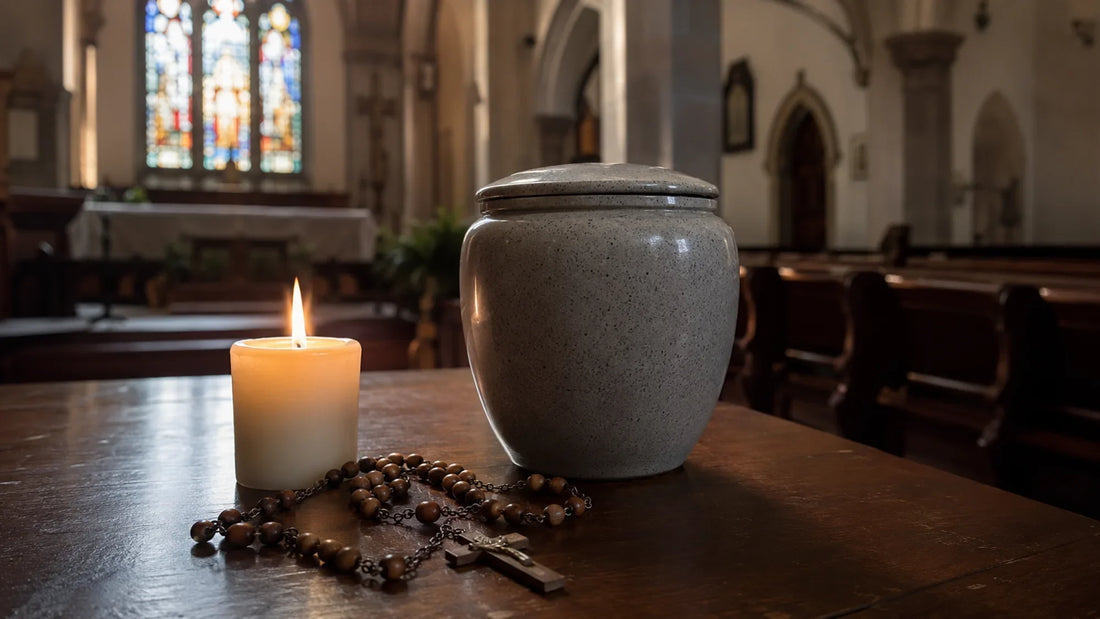
Can Catholics be cremated? Yes. The Catholic Church permits cremation. For many families, that answer comes as a relief, especially when they are trying to balance faith, cost, family tradition, and a loved one’s wishes at the same time.
But while the short answer is yes, the fuller answer is more specific. The Church allows cremation, yet it still prefers burial of the body and gives clear guidance about how cremated remains should be treated afterward.
This distinction matters. Many people have heard conflicting things over the years. Some were told that cremation is not allowed for Catholics. Others assume that because cremation is permitted, the Church sees no real difference between cremation and burial. Neither view is quite right.
Catholic teaching is more careful than that. Cremation itself is not forbidden, but it is not meant to be approached casually or in a way that ignores the dignity of the body.
For grieving families, the confusion usually shows up in practical questions. Can there still be a Catholic funeral Mass? Is it acceptable to choose cremation for financial reasons? Can ashes be kept at home? Can they be scattered in a place the person loved? These are the questions that often matter most when arrangements have to be made quickly.
The good news is that the Church’s guidance is clear enough to help families make respectful and faithful decisions. Catholics can be cremated, but the Church asks that the choice be made for the right reasons and that cremated remains be handled with reverence.
The Short Answer
Yes, Catholics can be cremated. The Catholic Church permits cremation as long as it is not chosen as a way of rejecting Christian teaching, especially belief in the resurrection of the body. In other words, cremation is not considered sinful in itself, and it does not prevent a Catholic funeral.
At the same time, the Church still prefers burial of the body. That preference is not based on the idea that cremation would somehow make resurrection impossible. Catholic teaching does not say that. Rather, burial is seen as the fuller sign of respect for the human body and the clearer expression of Christian hope in the resurrection.
So the most accurate way to put it is this: cremation is allowed, burial is preferred, and cremated remains must still be treated with the same dignity owed to the body of the deceased.
Why So Many Catholics Are Confused About Cremation
The confusion is understandable. For many years, Catholics often heard burial presented as the proper Christian choice and cremation as something at least strongly discouraged. In older generations, that practical message sometimes became simplified into a rule people remembered as “Catholics cannot be cremated.” Even though Church discipline changed long ago, the older impression stayed in many families.
There is also confusion because several separate questions tend to get blended together. One question is whether cremation is allowed at all. Another is whether it is the Church’s preferred practice. Another is what can be done with the ashes afterward. Those are related questions, but they do not all have the same answer.
A Catholic may be cremated. That is permitted. But that does not mean every custom connected to cremation is also permitted. The Church allows cremation while still setting boundaries about the care, storage, and final resting place of the remains. Once those questions are separated, the teaching becomes much easier to understand.
What the Church Actually Teaches About Cremation
The Church’s teaching starts with the dignity of the human person. In Catholic belief, the body is not just a shell that no longer matters after death. The body has been part of the person’s life, relationships, suffering, worship, service, and identity. Because of that, the Church teaches that the dead should be treated with reverence and respect.
That belief explains both sides of the Catholic position. On the one hand, cremation is permitted because it does not destroy Christian hope. God is not limited by the physical condition of human remains. A person who has been cremated is no less within God’s power than a person who has been buried, lost at sea, or otherwise physically destroyed by circumstances of death.
On the other hand, the Church still expects the remains of the deceased to be treated in a way that reflects faith and dignity. The issue is not only what is technically allowed, but what best expresses Christian respect for the person who has died. That is why the Church permits cremation but does not treat it as merely a matter of convenience or personal taste.
Why Burial Is Still Preferred
Even though cremation is allowed, burial remains the preferred Catholic practice. This is important because some families hear “permitted” and assume it means “equally preferred.” That is not the Church’s position.
Burial has long held a special place in Christian life because it reflects the pattern of Christ’s own death, burial, and resurrection. It expresses reverence for the body and the hope that death is not the end. It also provides a stable place for mourning, prayer, remembrance, and the witness of faith.
Burial is also a visible way of showing that the body still matters. In Catholic teaching, the body is not disposable. The Church’s preference for burial reminds the faithful that death is approached with hope, patience, and honor, not simply with efficiency.
That does not mean families who choose cremation are being unfaithful. It means the Church sees burial as the richer symbol, while still recognizing that cremation may be chosen for legitimate reasons such as cost, family circumstances, social conditions, or practical realities.
Does Cremation Conflict With Belief in the Resurrection?
No. This is one of the most common worries, and it deserves a direct answer. The Catholic Church does not teach that cremation blocks or weakens the resurrection of the body. God’s power is not limited by the condition of mortal remains. The resurrection is an act of God, not a biological process dependent on preserving the body in one particular way.
What matters is the meaning behind the choice. If someone were to choose cremation specifically as a statement against Christian belief, that would be a different matter. But cremation chosen for practical, economic, cultural, or family reasons is not the same thing. The problem would be the rejection of the faith, not the cremation itself.
This distinction helps many Catholic families. They do not need to fear that choosing cremation for understandable reasons is somehow a denial of resurrection. It is not. The Church’s concern is less about the method alone and more about the faith, intention, and reverence that surround it.
Can There Still Be a Catholic Funeral Mass?
Yes. A Catholic who is cremated can still receive the Church’s funeral rites. In fact, the Church encourages families to keep cremation within the framework of prayer, liturgy, and Christian mourning rather than treating it as something separate from the life of the Church.
Traditionally, the Church prefers that the funeral rites be celebrated with the body present before cremation takes place. This remains the clearest and most strongly preferred form. In that arrangement, the Vigil, Funeral Mass, and committal are celebrated in continuity, with cremation occurring afterward if that is the chosen form of final disposition.
In some places, including the United States under approved norms, cremated remains may also be present for the funeral liturgy. Even then, many parishes still encourage families to ask early about local practice so that the funeral can be planned in a way that follows diocesan guidelines and parish custom.
The important point is that cremation does not remove a Catholic from the Church’s funeral care. Families can still have a Vigil, a Funeral Mass, prayers of commendation, and a proper rite of committal.
What the Church Says About Ashes
This is where Catholic teaching becomes more concrete. Once cremation has taken place, the cremated remains are to be treated with respect and laid to rest in a sacred place. In practical terms, that usually means a cemetery, mausoleum, columbarium, or another place set aside for this purpose by ecclesiastical authority.
The Church uses this requirement to protect both reverence and memory. A sacred resting place helps ensure that the deceased remains part of the prayers of the family and the wider Christian community. It also helps prevent the remains from being treated as ordinary property, forgotten over time, or handled in a way that no longer reflects the dignity of the person.
For Catholic families, this means that deciding on cremation is only part of the process. The equally important question is where the cremated remains will be placed afterward. The Church’s answer is not vague: they should be laid to rest reverently in a sacred place.
Can Catholics Keep Ashes at Home, Scatter Them, or Divide Them?
Ordinarily, no. As a general rule, the Church does not permit cremated remains to be scattered in the air, on land, at sea, or in another place of personal significance. It also does not approve of dividing ashes among family members or preserving them in jewelry, keepsakes, or decorative objects. Likewise, keeping ashes permanently at home is not the ordinary Catholic practice.
These rules can be surprising, especially when a family believes that scattering ashes in a favorite place is a loving gesture. But the Church’s reasoning is consistent. The remains of the deceased are not meant to become private mementos or symbols detached from prayer and the community of faith. They are to be treated as the mortal remains of a person made in the image of God.
There can be rare, exceptional situations that require pastoral judgment, but families should not assume exceptions apply automatically. The normal Catholic approach is simple and clear: cremated remains belong in a sacred resting place, not scattered, split up, or casually stored.
Is It Acceptable to Choose Cremation for Financial Reasons?
Yes. Many families consider cremation because it is less expensive than a traditional burial, and choosing cremation for that reason is not, by itself, contrary to Catholic teaching. Cost is a real concern for many households, and the Church does not require families to ignore financial reality in order to prove their faith.
This is an important point because some Catholics feel guilty when budget is part of the decision. They may worry that if burial is preferred, cremation chosen for economic reasons must be less respectful or less faithful. That is not a fair conclusion. The Church’s preference for burial does not mean every family is morally required to choose the most expensive option.
What matters is how cremation is chosen and how the remains are treated afterward. A simple cremation followed by respectful burial or entombment in a sacred place can be entirely consistent with Catholic practice. Reverence is not measured only by cost.
What Catholic Families Should Ask Before Making Arrangements
If your family is considering cremation, it helps to ask a few clear questions early:
- Would the parish prefer the funeral rites with the body present before cremation?
- If cremation occurs first, can the cremated remains be present for the Funeral Mass under local norms?
- Where will the cremated remains be buried or entombed?
- Does the parish cemetery or a local Catholic cemetery have columbarium or burial options?
- Are there diocesan guidelines the family should know before final decisions are made?
These questions help families avoid last-minute confusion. They also shift the conversation from general assumptions to practical planning. In many cases, a brief conversation with the parish or funeral director can make the path much clearer.
Bottom Line
Can Catholics be cremated? Yes. The Catholic Church permits cremation. But the fuller answer is that burial remains the preferred practice, and cremated remains are to be treated with reverence and placed in a sacred location.
That means cremation is not forbidden, but it is also not something the Church sees as purely private or purely practical. The body matters. The funeral rites matter. The final resting place matters. Catholic teaching asks families to approach cremation in a way that reflects hope in the resurrection and respect for the person who has died.
For most families, the best way to think about it is this: cremation can be a faithful Catholic choice when it is made for legitimate reasons and followed by a proper Catholic disposition of the remains. When handled that way, cremation does not stand outside the Church’s tradition. It can fit within it, provided it is carried out with dignity, prayer, and care.
Share
Continue reading


