
How Does Pet Cremation Sizing Work by Weight? A Clear Guide for Pet Owners
Pet cremation sizing by weight usually means the cremation provider places your pet into a weight range for planning and pricing. The exact ranges vary from one provider to another, but weight is commonly used to determine the quoted cost, the type of container needed, the amount of time required for the cremation, and the size of the temporary container or urn that may be appropriate afterward. It is an administrative and operational tool, not a reflection of your pet’s worth.
That distinction matters because many people feel uneasy when they hear their dog or cat described by weight category during a time of loss. In reality, providers use weight because it is one of the clearest ways to plan the cremation safely and accurately. A ten-pound cat, a fifty-pound dog, and a giant-breed dog do not require the same timing, space, or handling. Knowing how the system works can make the process feel less clinical and easier to navigate.
If you are arranging cremation for a beloved pet, the simplest answer is this: most providers sort pets into weight brackets, and those brackets help shape the quote and the logistics of care. The details are not identical everywhere, so the most useful thing a family can do is ask how that specific provider defines its size categories and whether the quoted price is based on actual weight, estimated weight, or a recent veterinary record.
What Pet Cremation Sizing by Weight Usually Means
When a pet cremation provider asks for your pet’s weight, they are usually trying to place your pet into a size category. Many providers have groups such as very small, small, medium, large, extra-large, or giant. Others use simple pound ranges. There is no single universal chart used by every pet crematory, which is why one provider’s large dog category may not match another provider’s category exactly.
Weight is used because it is more practical than breed alone. Breed can give a rough idea of size, but it is not precise enough for planning. A slender mixed-breed dog and a stockier dog of the same general height may fall into different weight categories. The same is true for cats, rabbits, and other companion animals. Weight gives the provider a clearer way to estimate what will be needed for the cremation process.
In some cases, providers also make special distinctions for birds, reptiles, pocket pets, or very large animals. Even then, weight still often plays a major role. The important thing to remember is that weight-based sizing is meant to support safe and organized care, not to reduce your pet to a number.
Why Providers Use Weight Categories
Weight categories help cremation providers plan several practical details at once. One is equipment and scheduling. Larger pets may require more time in the cremation chamber and may need to be scheduled with greater attention to equipment capacity and handling. Smaller pets may require less time and may fit into lower pricing tiers because the process is generally less resource-intensive.
Weight also affects transportation and intake. If a provider is picking up a pet from a home or veterinary office, they need a realistic idea of size so they can prepare appropriately. A small cat and a giant-breed dog are not handled the same way from a staffing and logistics standpoint. Accurate weight helps the provider ensure that transfer is carried out respectfully and safely.
Another reason is container planning. The temporary container used to return cremated remains, and the guidance given about urn size, can be influenced by the pet’s overall size. Families do not usually need to solve those details on their own, but the provider needs enough information to prepare properly. Weight is one of the most efficient ways to do that.
How the Weight Is Usually Determined
In many cases, the pet’s weight comes from a recent veterinary record. If a pet dies at a veterinary clinic or hospital, the clinic may already have a current or recent weight on file. That makes the intake process fairly simple. The cremation provider can use that record to place the pet in the correct category and prepare the quote or paperwork.
If the pet dies at home, families may be asked for their best estimate or for the most recent known weight. That is common and usually acceptable, especially if the provider is simply trying to determine which general weight tier applies. If the pet had recent illness-related weight loss or gain, it helps to mention that. A pet’s healthy weight from years earlier may not be the most useful number for current planning.
Some providers confirm weight at intake, while others rely on the information given by the veterinary office or owner unless there is a clear reason to revisit it. If your pet is near the top end of a category, it is reasonable to ask whether the final price depends on a confirmed weight or whether the quoted tier is locked in based on the information you provided.
What Happens If Your Pet Is Between Weight Categories
One of the most common points of confusion is what happens when a pet is near the border between two size tiers. The answer varies by provider. Some cremation companies round up once the pet passes a category limit. Others allow a little flexibility if the difference is minor. Some use the veterinary record exactly as written, while others may confirm the weight when the pet is received.
This is why transparency matters. If your dog normally weighed around fifty pounds but had dropped below that near the end of life, say so. If your cat’s weight is only an estimate, mention that too. Clear information helps avoid billing surprises later. Most providers would rather explain the category in advance than have a family feel confused or caught off guard afterward.
If your pet is right on the edge of a tier, ask a direct question: Which weight category would you place my pet in, and could that change later? That simple conversation often clears up uncertainty immediately.
Does Weight Change the Type of Cremation You Can Choose?
Usually, weight changes the pricing and logistics more than the basic service options. Many providers offer more than one type of cremation arrangement, such as a private or individually tracked option and a communal option. The names and definitions can vary by company, so families should always ask exactly how a provider uses its terms.
What matters here is that a larger pet is not automatically limited to a certain type of cremation just because of size. In most cases, weight determines the size tier, while the family still chooses the service level they want. The final price may reflect both decisions: the type of service and the pet’s weight category.
That said, very large pets can sometimes involve extra logistical considerations. A provider may need specialized scheduling, additional staff, or specific equipment. If your pet was especially large, it is worth asking whether there are any size-related limits or special arrangements you should know about.
How Weight Affects the Price of Pet Cremation
Weight is often one of the main factors in pet cremation pricing. The reason is not arbitrary. Larger pets generally require more time, more handling, and more operational planning. For that reason, many providers build their price lists around weight ranges. A smaller pet may fall into a lower tier, while a larger dog may fall into a higher one.
Still, weight is not usually the only thing that affects cost. The total price may also depend on whether the cremation is private or communal, whether there is home pickup, whether the family wants witness attendance if the provider offers it, whether an upgraded urn is selected, and whether there are after-hours or emergency arrangements. In other words, weight often sets the base category, but the final amount may reflect several choices together.
Because pricing structures vary, it is better to think in terms of categories rather than universal numbers. One provider may have several detailed weight tiers. Another may use only a few broad categories. The best approach is to ask for a written breakdown so you understand what is included in the quoted price.
How Weight Relates to the Cremated Remains Returned
Families also sometimes assume that the pet’s body weight directly predicts how much cremated remains will be returned. The relationship is not that simple. In general, larger pets tend to have more cremated remains than smaller pets, but the amount is not a direct pound-for-pound conversion. Cremated remains are primarily processed bone fragments after the cremation process is complete, so body composition matters.
This is why two pets with similar living weights may not produce exactly the same amount of remains. Age, bone structure, and overall body condition can all play a role. That is also why urn selection is usually based on the expected volume of remains rather than the pet’s original body weight alone.
For families, the practical takeaway is simple: weight gives the provider a useful starting point, but it does not create a perfectly exact formula for the amount returned. If you are choosing an urn yourself, the provider can usually help you select an appropriate size based on experience.
Choosing an Urn or Memorial Item Based on Size
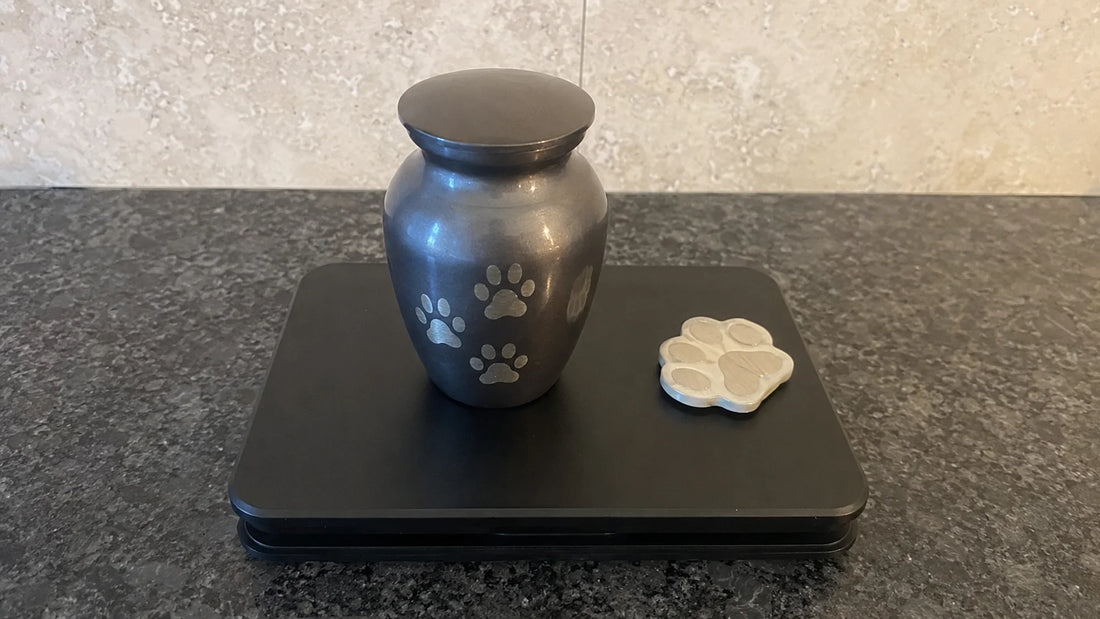
Many families discover that sizing by weight continues to matter after the cremation because it helps inform urn recommendations. A provider may suggest a larger urn for a large dog and a smaller urn for a cat or toy-breed dog. That guidance is useful, but families should remember that urn sizing is really about capacity, not just the number on the scale before cremation.
If you plan to keep the remains in a permanent urn, ask whether the urn is sized to hold all of the cremated remains or only a portion. This matters especially if you are considering keepsake jewelry, multiple small keepsake urns, or a decorative urn purchased separately from the cremation provider. Some families want one full-size urn. Others want the main remains in one urn with a small portion placed in a memorial item.
The most reliable approach is to tell the provider exactly what you want and let them guide you on size. That way, the memorial item fits the practical reality of the remains, not just the pet’s pre-cremation weight estimate.
Special Situations Families Should Know About
Some situations fall outside the most common weight-based categories. Giant-breed dogs, for example, may require special planning simply because of their size. A provider may need to confirm handling procedures, transportation details, or scheduling. That does not mean cremation is not available. It simply means the logistics may be more individualized.
Exotic pets can also be a little different. Birds, reptiles, rabbits, guinea pigs, and other small companions are often included in pet cremation services, but the way pricing is structured may differ from dog-and-cat pricing. Some providers use separate categories for these animals, while others still rely mainly on weight.
Another special case involves pets whose weight changed significantly near the end of life. If your pet had substantial fluid retention, major weight loss, or another medical condition that makes the number feel misleading, bring that up. The provider may still use the recorded weight for its category system, but an open conversation helps set expectations.
Questions to Ask a Pet Cremation Provider
If you want to avoid confusion, a few direct questions can help:
- How do you group pets by weight for pricing?
- Do you use actual weight, estimated weight, or the most recent veterinary weight?
- If my pet is near the edge of a category, could the price change?
- Does the quoted price include pickup, a standard container, and return of remains?
- How do you define your service options for private, individual, or communal cremation?
- Can you recommend an urn size based on my pet’s expected remains?
These questions are practical, but they also give families peace of mind. During grief, simple clarity matters. You should not have to guess how the provider is using weight or what is included in the fee.
Final Thoughts
So, how does pet cremation sizing work by weight? In most cases, the provider places your pet into a weight category, and that category helps determine pricing, scheduling, handling, and the practical details of aftercare. The exact ranges vary by provider, which is why there is no single industry chart that applies everywhere.
For families, the most important thing to know is that weight-based sizing is a planning tool. It helps the provider carry out cremation respectfully and efficiently, but it does not define your pet’s importance. If anything feels unclear, ask how the categories work, what weight will be used, and whether the quote could change. A good provider should be able to explain the process plainly and with compassion.
When families understand why weight matters and how the categories are applied, the process tends to feel less confusing. That clarity can make one difficult decision a little easier at a time when that matters most.
Share
Continue reading


