
How Many Cubic Inches Should an Urn Be for Ashes? A Simple Size Guide
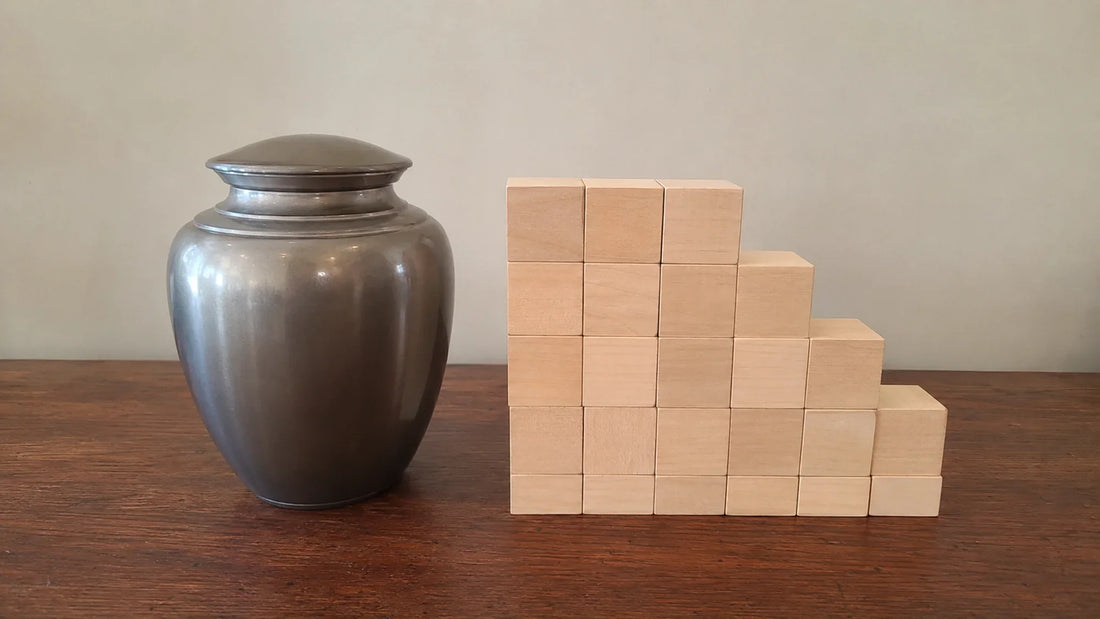
One of the most common questions families ask after cremation is simple but important: how many cubic inches should an urn be for ashes? The standard rule of thumb is to allow one cubic inch of urn capacity for each pound of body weight before cremation. So, if a person weighed 180 pounds, an urn with at least 180 cubic inches of interior capacity is usually the right size.
That basic formula answers the question quickly, but many families still feel uncertain when they begin choosing an urn. Product listings can be confusing, urns can look larger or smaller than expected, and most people do not spend much time thinking about cubic inches in everyday life. When the decision is happening during grief, even a simple size question can feel harder than it should.
The good news is that urn sizing is usually more straightforward than it first appears. Once you understand what cubic inches mean, why body weight is used as the estimate, and when you may want to size up, it becomes much easier to choose with confidence. In most cases, the goal is not to find the perfect mathematical number. It is to make sure the urn can comfortably hold all of the cremated remains and suit the family's plans for display, burial, travel, or sharing.
This guide explains how urn capacity works, how to estimate the right size, and what families should keep in mind before making a final choice.
What does urn capacity in cubic inches mean?
When an urn says it holds 200 cubic inches, that number refers to the interior volume of the urn. In other words, it tells you how much space is available inside the urn for the cremated remains. It does not refer to the height of the urn, the outside dimensions, or how large the urn appears on a shelf.
This is an important distinction because appearance can be misleading. Two urns may look nearly identical from the outside but have different interior capacities because of their shape, wall thickness, base design, or lid style. A decorative urn with thick sides may have less usable space than expected, while a simpler urn may hold more than it appears to at first glance.
That is why families should focus on the listed capacity rather than appearance alone. No matter how beautiful the urn looks, the interior cubic inch capacity is the number that determines whether it can hold the cremated remains properly.
The general rule: one cubic inch per pound
The most widely used sizing guideline is simple: choose an urn with one cubic inch of capacity for each pound of body weight before cremation. This rule is used because it gives a reliable estimate of the amount of space generally needed for cremated remains.
Here are a few common examples:
- If the person weighed 90 pounds, choose an urn with at least 90 cubic inches of capacity.
- If the person weighed 140 pounds, choose an urn with at least 140 cubic inches of capacity.
- If the person weighed 175 pounds, choose an urn with at least 175 cubic inches of capacity.
- If the person weighed 200 pounds, choose an urn with at least 200 cubic inches of capacity.
- If the person weighed 240 pounds, choose an urn with at least 240 cubic inches of capacity.
For most adult urn selections, this rule gives families a very practical starting point. It is also why many standard adult urns are made in a range of roughly 180 to 220 cubic inches. That range fits many adults, but it is not universal. Someone larger may need more capacity, while someone smaller may need less.
If you only remember one number from this guide, it should be this: one pound of body weight generally equals one cubic inch of urn capacity.
Why pre-cremation body weight is used
Families sometimes wonder why urn sizing is based on body weight before cremation rather than on the weight of the ashes afterward. The reason is that pre-cremation body weight provides a practical, consistent estimate of the volume of cremated remains that will need to fit inside the urn.
What people commonly call ashes are not light fireplace ashes. Cremated remains are primarily processed bone fragments, and the amount returned depends more on bone structure than many people realize. Because of that, the remains do not directly correspond to a person's total body weight after cremation. However, using pre-cremation body weight is still the simplest and most reliable standard for estimating urn size.
This is also why families should not try to guess urn size by how heavy the remains feel in the temporary container. The listed urn capacity is about volume, not just weight in the everyday sense. The standard rule exists to keep the process simpler and more predictable.
Should you choose the exact number or go slightly larger?
In most cases, it is wise to choose an urn that offers at least a little extra capacity rather than selecting one that exactly matches the estimated number. For example, if a person weighed 180 pounds, an urn with 185 or 200 cubic inches may be a safer choice than one listed at exactly 180.
There are a few reasons for this. First, body weight may only be known approximately. Second, urn interiors can vary slightly based on how they are designed and measured. Third, choosing a bit of extra space reduces the risk of a tight fit, which can create unnecessary stress when the remains are transferred.
An urn that is slightly larger is generally not a problem. An urn that is too small is. For that reason, many families and funeral professionals prefer to err on the side of a little more capacity rather than too little.
If you are close to the edge between two sizes, the larger option is usually the better one.
How much capacity does a standard adult urn usually have?
Many standard adult urns fall somewhere between 180 and 220 cubic inches. This range works for many adults, which is why it is so common in product listings. However, families should not assume that every adult urn will automatically fit every adult.
For example, a standard 200 cubic inch urn will usually be appropriate for someone who weighed around 200 pounds or less. If the person weighed substantially more than that, a larger urn may be needed. Some urns are specifically made with extra capacity for larger adults, and those are worth seeking out when needed rather than trying to make a standard urn work.
This is where the product description matters. Terms like “adult urn” can be helpful, but the cubic inch capacity is more important than the label. A decorative title does not tell you as much as the actual capacity number.
What if the urn is for a child or infant?
The same general principle applies for children and infants: urn sizing is still based on the amount of interior space needed for the cremated remains, and the one cubic inch per pound guideline remains a useful estimate. Naturally, the required urn capacity is much smaller than it would be for a typical adult urn.
Families choosing an urn for a child or infant often place extra importance on appearance, symbolism, and emotional meaning, which is completely understandable. Even so, the capacity still needs to be checked carefully. A smaller keepsake-style urn may look appropriate but may not hold all of the remains unless it is specifically designed to do so.
When selecting an urn in these circumstances, clarity matters. Make sure the capacity is listed and do not assume that a small urn will automatically be the correct size simply because it is intended for a child. As with adult urns, the interior capacity is what matters most.
What if you want to divide the ashes into multiple urns?
Not every family wants to place all of the cremated remains into one urn. In many cases, the ashes are divided among several family members using keepsake urns, smaller companion containers, or memorial jewelry. If that is the plan, the sizing calculation changes because you are no longer choosing one urn to hold the full amount.
For example, if a person weighed 180 pounds and the remains will be divided equally among three family members, each smaller urn would need to hold roughly one-third of the total volume. That would mean each container should have enough interior capacity for its intended portion, ideally with a little extra room rather than an exact fit.
This is one reason it helps to decide early whether the remains will stay together or be shared. Choosing urns first and deciding on division later can create unnecessary complications. If you know multiple family members want a portion, it is better to plan for that from the beginning so the correct urn sizes can be selected.
What about companion urns for two people?
A companion urn is designed to hold the cremated remains of two people. These urns are often chosen by spouses or partners who wanted to remain together after death. Because they are meant for two sets of remains, the required capacity is much larger than for a standard single-person urn.
To estimate the right size for a companion urn, you would combine the expected capacity for both people. For example, if one person weighed 160 pounds and the other weighed 180 pounds, a companion urn would generally need at least 340 cubic inches of capacity, and often slightly more for a comfortable fit.
Some companion urns are designed as one shared interior space, while others include two separate compartments. In either case, capacity still matters just as much. Families should check the listed total interior volume and make sure it is sufficient for both individuals rather than relying only on the phrase “companion urn.”
Does the type of urn affect the sizing decision?
Yes, in practical terms it can. The amount of capacity needed is still based on the cremated remains, but the type of urn may affect how carefully you need to check the listed interior space. Decorative urns, hand-crafted urns, biodegradable urns, wooden urns, ceramic urns, and metal urns can all be shaped differently, and their exterior appearance may not reflect their actual usable volume.
For example, a tall narrow urn may look as though it holds a great deal, but its interior space may be reduced by thick walls or a tapered base. A more compact urn may actually hold more because the interior chamber is more efficient. This is why the material and style of the urn do not replace the need to verify capacity.
If the urn is meant for burial, you may also need to consider whether an outer container, vault, or cemetery requirement applies. If the urn is meant for home display, you may care more about shape and appearance. But in all cases, capacity remains the essential number.
What happens if an urn is too small?
An urn that is too small can create a difficult and stressful situation. If all of the cremated remains do not fit, the family may need to choose another urn, add a keepsake urn, or keep part of the remains in a temporary container until a new plan is made. That is exactly the kind of complication most people want to avoid during an already emotional time.
This is why it is usually better to size up rather than choose the smallest possible option. A slightly larger urn does not harm anything. A too-small urn creates an immediate practical problem and can make the transfer of remains more upsetting than it needs to be.
If there is any uncertainty about the person's pre-cremation weight or about the capacity listing, giving yourself a margin of extra space is the safer choice.
How to estimate the right urn size when you do not know the exact weight
Sometimes families do not know the person's exact weight before cremation. In that case, the best approach is to make a reasonable estimate and then choose an urn with some extra capacity rather than aiming for a precise minimum. The goal is not perfect mathematical accuracy. The goal is to make sure the urn is large enough.
If you are unsure whether the person was closer to 170 pounds or 190 pounds, choosing an urn in the 200 cubic inch range is usually more sensible than picking one at 175 and hoping it fits. When in doubt, a little extra room is better than too little room.
Funeral homes and cremation providers can also often give guidance if the remains are still in their care or if they know the approximate size needed. Families do not need to solve the estimate entirely on their own.
Common sizing examples for quick reference
Families often want a quick way to translate the general rule into real decisions. The following examples can help:
- Small adult: around 120 to 150 pounds often means an urn in the 120 to 150 cubic inch range, with a little extra space preferred.
- Average adult: around 160 to 200 pounds often means an urn in the 160 to 200 cubic inch range, with many standard adult urns fitting this category.
- Larger adult: over 200 pounds may require a larger-than-standard urn, depending on the exact weight.
- Shared remains: divide the estimated total cubic inches among the intended containers and allow some extra room in each.
- Companion urn: add both individuals' estimated needs together and choose a companion urn with at least that much total capacity.
These are not hard legal categories. They are simply practical ways to think through the sizing process without making it more complicated than necessary.
Questions to ask before buying an urn
If you want to avoid sizing mistakes, a few simple questions can help:
- What is the exact interior capacity in cubic inches?
- Is that capacity for all of the remains or only for a portion?
- Is the urn meant for one person or for a companion arrangement?
- Will the ashes be divided into multiple urns or keepsakes?
- Do I know the person's approximate pre-cremation weight?
- Would choosing a slightly larger urn make more sense in this case?
- Is the urn intended for display, burial, placement in a niche, or travel?
These questions bring the decision back to the practical essentials. Once capacity is confirmed, families can focus more comfortably on the appearance, material, and personal meaning of the urn they choose.
Final thoughts
So, how many cubic inches should an urn be for ashes? In most cases, the answer is about one cubic inch for each pound of body weight before cremation. That means a 150-pound person usually needs about 150 cubic inches of urn capacity, and a 200-pound person usually needs about 200 cubic inches.
While that rule is simple, the best practical advice is to choose an urn with at least the needed capacity and, when possible, a little extra room. This helps avoid complications and makes the process easier for the family. The most important detail is not how large the urn looks from the outside, but how much space it actually holds inside.
Once capacity is taken care of, families can focus on the more personal part of the decision: choosing an urn that feels respectful, appropriate, and meaningful. In that sense, understanding cubic inches is not just a technical detail. It is what allows the practical side of the decision to feel clear, so the emotional side can receive more attention.
Share
Continue reading


