
How Much Do Cremated Ashes Weigh?
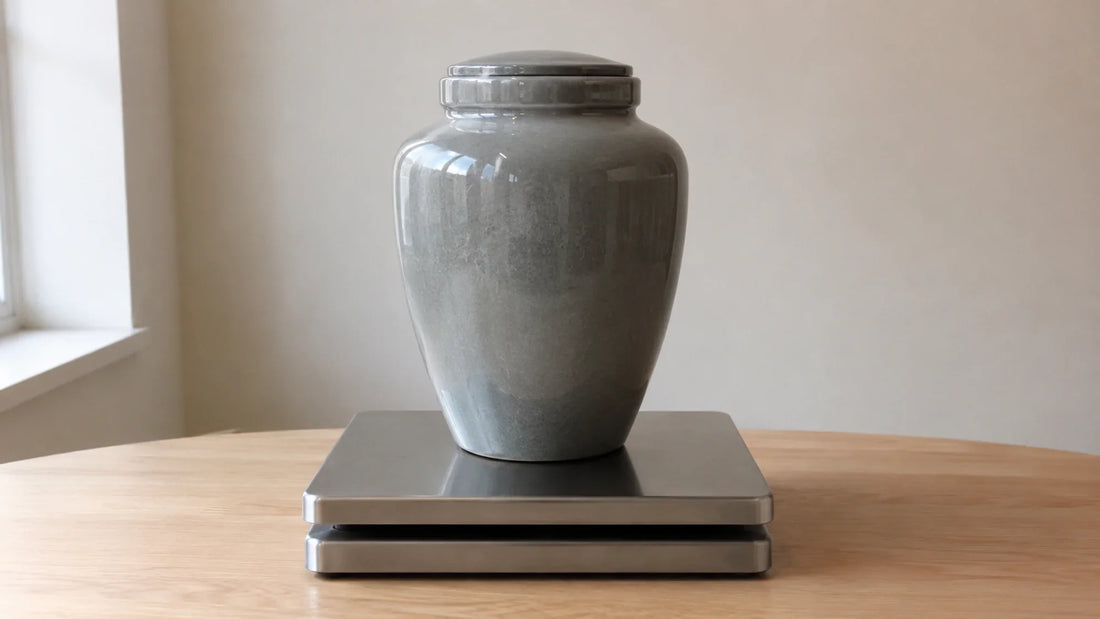
When families ask, “How much do cremated ashes weigh?” they are usually trying to answer a practical question during an emotional time. They may be choosing an urn, planning to divide the remains among family members, arranging burial in a cemetery, or preparing for scattering. It is a simple question on the surface, but it also carries a lot of meaning. People want to know what to expect.
For traditional flame cremation, the answer is usually more modest than most people imagine. Cremated remains do not weigh anything close to a person’s full body weight. After cremation, what remains are primarily the mineral components of bone, processed into a fine, sand-like consistency. The body’s water, soft tissue, organs, and fat are not part of the final remains.
That is why the final weight is typically measured in pounds, not dozens or hundreds of pounds. It also explains why two people with very different body weights can sometimes have a surprisingly similar amount of cremated remains. Bone structure matters much more than most families expect.
If you are trying to plan ahead or make arrangements right now, the helpful takeaway is this: there is a normal range, but there is not one exact number for everyone. A good funeral home or crematory can help you estimate what to expect and choose an urn or memorial option that fits comfortably.
The Short Answer
Most adult cremated remains weigh about 4 to 6 pounds. Smaller adults may be below that range, while larger-framed adults may be somewhat above it. Children and infants will, naturally, leave behind significantly less.
That means the average set of cremated remains is often lighter than families expect, but also denser than they imagine. In the hand, cremated remains usually feel heavier than fireplace ash because they are made up largely of processed bone fragments rather than soft, powdery soot.
Why Cremated Ashes Do Not Weigh What the Body Weighed
A common misconception is that cremated ashes somehow reflect a person’s total body weight. They do not. During cremation, heat reduces the body to its basic skeletal remains. The body’s water content evaporates, and the soft tissues are consumed by the process. What remains afterward are bone fragments, which are then carefully processed into the consistency families recognize as ashes.
This is one reason many funeral professionals prefer the term cremated remains. The word ashes is widely used and completely understandable, but it can give the impression that the remains are like the loose ash left in a fireplace or campfire. In reality, they are denser and more granular because they come from bone.
Understanding that basic point makes the weight question easier to answer. The final amount depends much more on how much bone remains than on how much the person weighed overall. A person’s soft tissue, body fat, and fluids do not add to the final weight in the way many people assume.
What Actually Affects the Weight of Cremated Remains
Several factors can influence how much cremated ashes weigh, but they mostly come back to skeletal size and density rather than simple body weight.
- Height and frame size: Taller people and people with larger skeletal frames often leave behind more cremated remains because there is simply more bone structure present.
- Bone density: Denser bones can result in somewhat heavier remains. This is one reason there is no exact number that fits everyone.
- Sex-based skeletal differences: On average, men often have larger and denser bones than women, which can place them toward the higher end of the usual adult range. That is an average, not a rule for every individual.
- Age and physical development: Children and infants have much smaller skeletons, so the resulting cremated remains weigh much less than an adult’s.
- Unique body characteristics: Two adults of the same weight may still have noticeably different amounts of cremated remains if one has a taller frame or more substantial bone structure.
What usually does not determine the final weight in a direct way is body fat. A person who carried extra body weight because of fat tissue will not necessarily have more cremated remains than a leaner person. In many cases, a taller or more broad-framed person with greater skeletal mass will leave behind more remains than a shorter person who weighed more overall.
This is why there is no perfect formula based only on body weight. It may help with rough planning, but it is not the same thing as predicting the exact pounds of cremated remains a family will receive.
Typical Ranges Families May See
Although every person is different, families often find it helpful to hear what is common in real-life arrangements.
For an average adult, a range of about 4 to 6 pounds is a useful expectation. Some smaller adults may be under that, while some larger-framed adults may be over it. If your loved one was especially tall or had a particularly large skeletal frame, the amount may be higher than what families think of as “average.”
For children, the weight is naturally much lower because the skeleton is smaller. For infants, it is lower still. In those situations, funeral homes often help families choose smaller containers, keepsake urns, or other memorial options that are sized appropriately.
The key point is not to focus too rigidly on a single number. The average range is useful for planning, but individual variation is normal. If you need a precise estimate for an urn, niche, or memorial product, it is always reasonable to ask the provider handling the cremation what size container they recommend.
Weight and Volume Are Not the Same Thing
One of the most helpful things families can learn is that weight and volume are not the same when it comes to cremated remains. A set of remains may weigh only a few pounds, but it still needs a container with enough interior space to hold it properly.
That matters because urns are sized by capacity, not simply by pounds on a label. A family may hear that the remains weigh about five pounds and assume that almost any small decorative urn will work. In practice, what matters is whether the urn has enough internal room for the full amount.
For many adults, a standard adult urn will be appropriate. But if your loved one was especially tall, broad-framed, or outside the average range, it is wise to confirm the needed capacity before buying an urn online or purchasing a cemetery niche. If you plan to divide the remains among several family members, that is another reason to think in terms of both weight and volume.
If you are uncertain, ask the funeral home or crematory before selecting a permanent urn. Most providers can place the cremated remains in a temporary container first, giving your family time to choose something that is the right size and style.
Why Cremated Ashes Can Feel Heavier Than Expected
Many people are surprised by the physical feel of cremated remains. Even though the total weight is usually only a few pounds, they often feel heavier than expected when lifted. That is because the remains are fairly dense.
Again, this comes back to what they actually are. They are not fluffy ash. They are processed bone fragments with a texture more like coarse sand than soot. That denser texture is one reason a modest amount by weight can still require a thoughtfully sized urn.
Common Questions Behind the Weight Question
When someone asks how much cremated ashes weigh, they are often really asking one of several related questions. These are some of the most common concerns behind the question.
- Will a heavier person always have more ashes? Not necessarily. Skeletal size and bone density usually matter more than body fat or total body weight alone.
- Do all adults leave behind the same amount? No. Most adults fall into a fairly predictable general range, but individual differences are normal.
- Can the remains be divided between family members? Yes, in many cases they can. Families often use keepsake urns, memorial jewelry, or multiple small containers when they want to share portions of the cremated remains.
- Do I need to buy an urn right away? Usually not. Many crematories can return the remains in a temporary container until the family decides on a permanent urn or memorial plan.
These practical questions are one reason transparency matters so much in funeral service. Families are not asking out of curiosity alone. They are trying to make thoughtful decisions for a person they love.
What This Means for Urn Selection and Memorial Planning
If you are choosing an urn, the safest approach is not to guess. Start with the provider’s recommendation, especially if your loved one was outside the average adult range or if you are ordering something custom.
You may also want to think ahead about how the remains will be handled. Will they be kept at home? Buried in a cemetery? Placed in a columbarium? Divided among relatives? Scattered, with a portion retained? The answer can affect not only the style of urn you choose, but the size and number of containers you need.
For example, a family that plans to scatter most of the remains but keep a small amount may choose one temporary container, one keepsake urn, or several small pieces of memorial jewelry. A family planning burial or inurnment may need to confirm both the urn size and any cemetery requirements before making a final purchase.
In many cases, a short conversation with the funeral home can prevent costly mistakes and unnecessary stress. That is especially useful if you are shopping online, where a container may look large in photos but have a smaller interior capacity than you expect.
Final Thoughts
So, how much do cremated ashes weigh? For most adults, the answer is usually around 4 to 6 pounds, with some variation depending mainly on skeletal size and bone density. That number is lower than many families expect, but it makes sense once you understand that cremated remains are primarily processed bone fragments rather than the full body reduced to soft ash.
If you are making cremation arrangements now, try not to worry about finding the exact number on your own. A reputable funeral home or crematory can explain what to expect, help you think about both weight and volume, and guide you toward an urn or memorial option that fits your loved one with dignity and care.
In the end, the weight of cremated remains is only one small practical detail in a much larger act of remembrance. Still, knowing what is normal can make planning feel a little more manageable at a difficult time, and that clarity can be a genuine comfort.
Share
Continue reading


