
What Size Cremation Urn Do I Need? A Simple Guide for Families
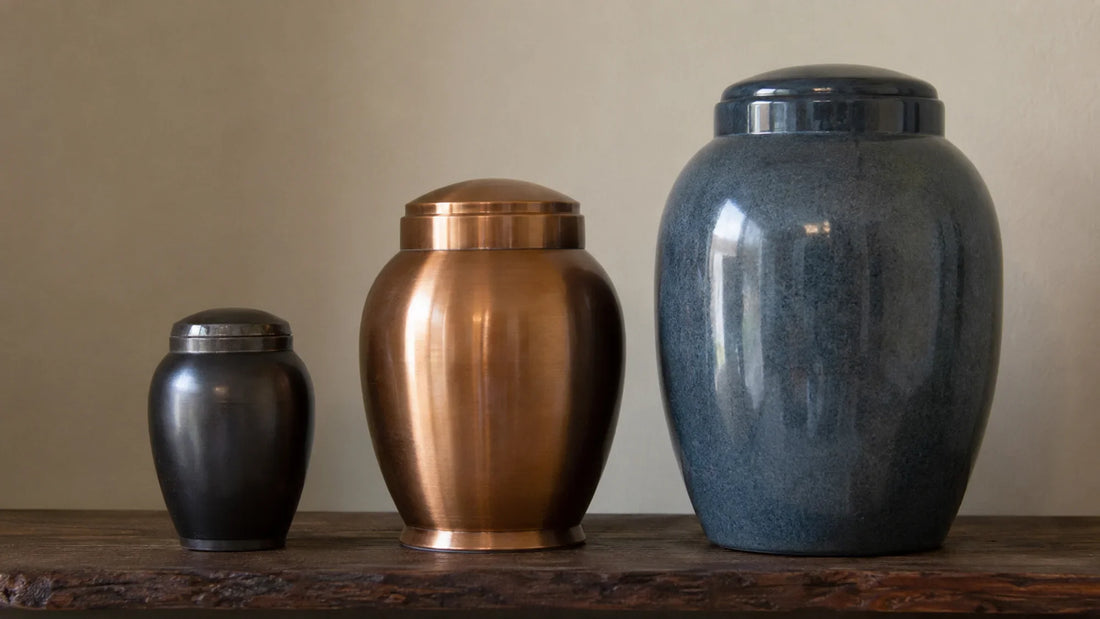
Choosing an urn sounds simple until you start looking at the options and realize every product lists a different capacity. Families often see terms like “standard adult urn,” “companion urn,” “keepsake urn,” or “200 cubic inches” and are not sure what any of it really means. In the middle of making funeral or cremation arrangements, that uncertainty can add stress to a decision that should feel straightforward.
If you are wondering what size cremation urn you need, the best place to start is with the standard rule of thumb used across the industry: allow about one cubic inch of urn space for every pound of body weight before cremation.
In practical terms, that means someone who weighed 150 pounds will usually need an urn with at least 150 cubic inches of capacity, while someone who weighed 200 pounds will usually need an urn with at least 200 cubic inches of capacity. When in doubt, choosing slightly larger is usually better than choosing too small.
That simple guideline answers most questions right away, but there are still a few details that matter. Not every urn is made for the same purpose. Some are intended to hold all of one person’s cremated remains.
Some are designed for two people. Some are keepsake urns meant to hold only a small portion of the remains. Others are made for scattering, burial, niche placement, or sharing the remains among several family members. Once you understand how sizing works, choosing the right urn becomes much easier.
The basic rule: one pound usually equals one cubic inch
The easiest way to estimate urn size is to use the standard one-to-one guideline. For most adults, you should plan on at least one cubic inch of urn capacity for every pound of body weight before cremation. This does not mean the cremated remains literally weigh the same as the person did in life. It simply means that pre-cremation body weight is the practical measure most families and funeral providers use when selecting an urn.
Here is what that looks like in everyday terms:
- A person who weighed 120 pounds will usually need an urn of at least 120 cubic inches
- A person who weighed 175 pounds will usually need an urn of at least 175 cubic inches
- A person who weighed 200 pounds will usually need an urn of at least 200 cubic inches
- A person who weighed 240 pounds will usually need an urn of at least 240 cubic inches
This is why many standard adult urns are made in capacities that work for a broad range of adults. If an urn is labeled 200 cubic inches, it is generally intended for someone who weighed up to about 200 pounds. If the person weighed more than that, you would usually want a larger option.
Because urn capacity is about space rather than appearance, two urns that look similar on the outside may hold different amounts. That is why the cubic-inch measurement matters more than the style name alone. “Adult urn” tells you the general category, but the capacity tells you whether it will actually fit.
Why urn sizes are measured in cubic inches
Families sometimes assume urns are sized by weight, height, or exterior dimensions. In reality, the key number is the internal capacity, which is usually listed in cubic inches. That number tells you how much cremated remains the urn can hold.
This can be confusing because the outside size of an urn does not always tell the whole story. Thick materials, decorative shaping, curved sides, or a narrow opening can affect the interior space. That is why it is possible to look at two urns that seem nearly identical but find that one holds more than the other.
When shopping for an urn, always look for the capacity listing rather than guessing from the photo or the dimensions alone. Exterior dimensions still matter in some cases, especially if the urn will be placed in a niche, buried in a vault, or displayed in a specific location at home. But for making sure the cremated remains will fit, the capacity number is the measurement that matters most.
What counts as a standard adult urn
Most adults are placed in what is considered a standard adult urn. In general, this category covers urns made to hold the full cremated remains of one adult. Many standard adult urns fall somewhere around the 180 to 220 cubic inch range, which works well for a large number of people. That is why you will often see so many urns sold in that size range.
If the person weighed less than that range, a standard adult urn will usually provide more than enough space. If the person weighed near the upper end of that range, you will want to check the listed capacity carefully instead of relying on the phrase “standard adult urn” by itself. A standard adult urn that holds 180 cubic inches is not the same as one that holds 220 cubic inches.
For many families, the safest approach is to buy a standard adult urn that offers a little extra room. There is no problem with choosing an urn that is slightly larger than the minimum estimate. In fact, that often gives families peace of mind, especially if the person’s exact weight is uncertain or if the urn style has an inner bag or insert that slightly changes usable space.
When you may need an oversized urn
Not every adult urn is large enough for every adult. If the person weighed more than the capacity listed for a standard urn, you will likely need an oversized urn. These urns are specifically designed to hold a larger volume of cremated remains while still offering the same range of materials and styles found in smaller options.
Oversized urns are a good choice when the person’s pre-cremation weight was above the capacity of most standard adult urns. They are also helpful when you want a little more room rather than fitting very close to the limit. Families sometimes assume that an urn listed as “adult” will work for any adult, but that is not always true. The capacity number should guide the decision.
If you are choosing between two urns and one is close to the estimated need while the other gives more room, the larger one is usually the safer option. The goal is to avoid a situation where the urn is just barely too small. That is an easy problem to prevent by selecting enough capacity from the start.
How companion urns work
A companion urn is designed for two people rather than one. Some families choose a companion urn for spouses or partners, either because both people have already been cremated or because one person wants a shared resting place in the future. Companion urns can be meaningful, but they require a different sizing approach.
Instead of using one person’s weight, you need enough total capacity for both sets of cremated remains. The simplest way to estimate that is to add the two body weights together and choose a companion urn with at least that much capacity. For example, if one person weighed 140 pounds and the other weighed 180 pounds, you would generally want a companion urn with at least 320 cubic inches of capacity.
Not all companion urns are meant to hold the full remains of two people. Some are symbolic designs with divided compartments that hold only portions. That is why reading the product description carefully matters. The phrase “companion urn” describes the purpose or style, but the actual listed capacity tells you whether it is intended to hold everything or just a small amount from each person.
Smaller urns for children, infants, and keepsake use
Not every urn selection involves a standard adult size. Smaller urns are often chosen for infants, children, or families who plan to keep only a portion of the cremated remains in one container. In these cases, the same basic principle applies: choose capacity based on the amount of remains the urn is intended to hold.
For infants and children, funeral homes and urn providers can usually help families select an appropriately sized urn based on weight and the family’s wishes. Because these situations are especially sensitive, many families prefer guidance rather than estimating on their own.
Keepsake urns are different from full-size urns. They are made to hold a small portion of cremated remains, not all of them. Families often choose keepsake urns when multiple relatives want a small personal memorial, or when the main urn will stay with one person while others keep a symbolic amount. The same is true for cremation jewelry and miniature urns. These are meaningful options, but they are not designed to replace a full-capacity urn unless only a small portion of the remains will be stored there.
What if the remains will be divided among family members
Many families no longer keep all cremated remains in a single urn. Some divide them among siblings or close relatives. Some place part in a keepsake urn and scatter the rest. Others use a main urn for most of the remains and smaller keepsake pieces for additional family members. If that is your plan, urn sizing becomes more flexible.
If one urn will hold all of the cremated remains, that urn still needs full capacity based on the person’s weight. Any keepsake urns would then hold only a small portion. If the remains will be divided more evenly, you can estimate the capacity each person needs based on the portion they will receive. For example, if three adult children are each keeping roughly one-third of the remains, each urn would need enough space for that share rather than the full amount.
Because dividing remains can be emotional and practical at the same time, it helps to decide in advance how much each container is supposed to hold. That prevents confusion later and makes it easier to order the right number and size of urns before the remains are returned or transferred.
Do scattering urns and temporary containers still need the right capacity?
Yes. Even if you do not plan to keep the cremated remains permanently in a decorative urn, the container still needs enough space to hold them. Scattering urns, temporary containers, and simple storage boxes are all made with capacity in mind. They may look different from traditional decorative urns, but the same sizing principle still applies.
Many crematories and funeral homes provide a temporary container if the family has not chosen a permanent urn yet. That temporary container is usually sized appropriately for the remains. If you later select a decorative urn, you can use the same capacity rule to make sure the new urn is large enough.
If you plan to scatter the remains, you may still want a container that is easy to carry, open, and handle outdoors. In that case, both capacity and function matter. A beautiful urn that is difficult to open or pour from may not be the best fit for a scattering ceremony, even if the size is correct.
Other details that can affect your choice
Urn size is the first question, but it is not the only one. Once you know the capacity you need, there are a few other practical details worth considering. Material matters if the urn will be displayed at home, buried, placed in a niche, or used for travel. Shape matters if shelf space is limited. Exterior dimensions matter if the urn needs to fit inside a columbarium niche, an urn vault, or another memorial space.
It is also worth thinking about how the urn will be used over time. Will it remain in one place at home? Will it be buried? Will it be carried to a service? Will family members eventually move it? These questions do not change the required capacity, but they can affect which style is most practical.
If you are choosing an urn for niche placement, always check the niche dimensions in addition to the urn capacity. An urn can be large enough internally but still too tall, too wide, or too deep for the space where it is meant to go. Capacity and exterior size are related, but they are not the same thing.
The simplest way to choose with confidence
For most families, choosing the right urn size comes down to three steps. First, start with the person’s pre-cremation body weight. Second, choose an urn with at least that many cubic inches of capacity. Third, go slightly larger if you are uncertain or if you want extra peace of mind.
That means most adults will need a standard adult urn, some people will need an oversized urn, and companion urns are best calculated by combining the estimated capacities for two people. Keepsake urns, jewelry, and miniature urns are for partial remains only unless the listing clearly says otherwise.
If you are ever unsure, ask the funeral home, crematory, or urn provider to confirm the capacity before purchasing. This is a very common question, and they should be able to help. Once you understand the one-cubic-inch-per-pound guideline, the decision becomes much less intimidating.
An urn is both a practical container and a meaningful memorial. Getting the size right helps ensure that one part of the process feels settled and straightforward, so your family can focus on choosing the style, material, and tribute that feels most fitting.
Share
Continue reading


