
What Size Urn Do I Need for My Dog’s Ashes?
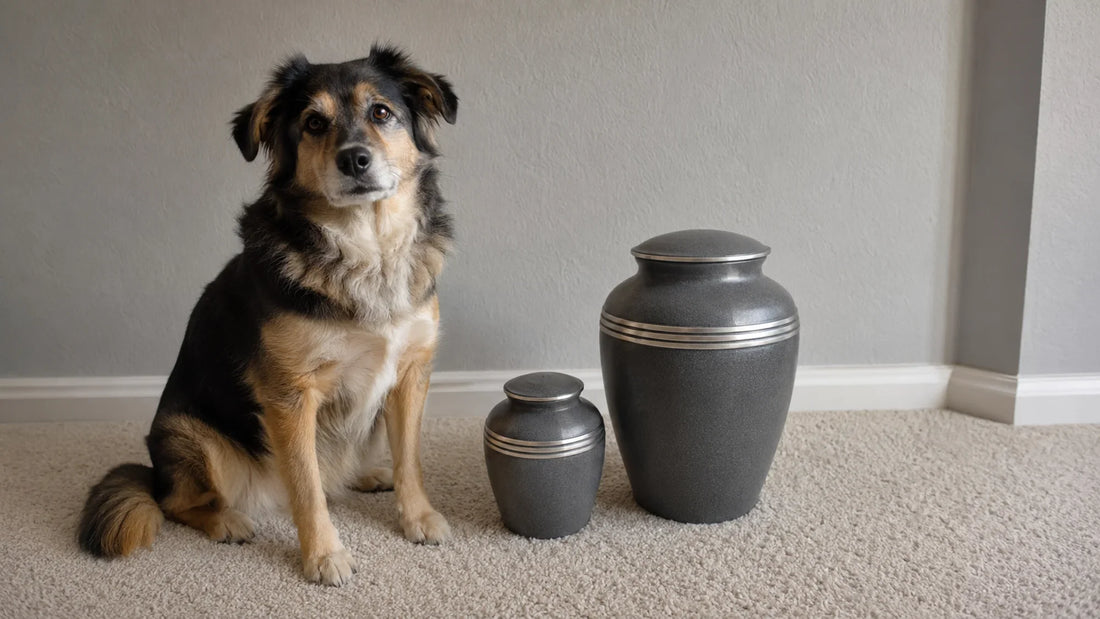
Choosing an urn for your dog can feel like a small decision until you actually have to make it. Then it suddenly carries a lot of weight. Many people want something beautiful and meaningful, but they also want to make sure it is the right size.
One of the most common concerns is simple and practical: how do you know whether the urn will actually hold your dog’s ashes?
The good news is that urn sizing is usually more straightforward than it first appears. In most cases, you can start with one basic rule of thumb and make a small adjustment from there if needed. Once you understand how pet urn capacity works, the process becomes much less stressful.
If you are shopping after a recent loss, it can also help to know that you do not have to get everything perfect on the first try.
Many families receive their dog’s cremated remains in a temporary container first, then choose a permanent urn once they have had a little time to think. That can take some pressure off an already emotional moment.
Here is how to figure out what size urn you need for your dog’s ashes, what “urn size” actually means, and when it makes sense to choose a slightly larger option.
The Basic Rule: Start With One Cubic Inch Per Pound
The most common guideline for pet urn sizing is simple: choose about one cubic inch of urn capacity for every pound your dog weighed before cremation. In other words, if your dog weighed 40 pounds, you would typically look for an urn with at least 40 cubic inches of capacity. If your dog weighed 75 pounds, you would usually want at least 75 cubic inches.
This rule is not meant to be mathematically perfect in every single case, but it is the standard starting point because it works well for most dogs. The cremated remains from a larger dog usually take up more space than the remains from a smaller dog, so body weight is the easiest and most reliable guide for choosing an urn size.
What matters here is that you are looking at your dog’s weight before cremation, not the weight of the ashes afterward. People are sometimes surprised by that. Urn size is based on volume, not on how heavy the remains feel in your hands.
If you remember only one thing from this topic, remember this: one pound of body weight usually calls for about one cubic inch of urn capacity.
Urn Size Means Capacity, Not the Outside Dimensions
One reason urn shopping can be confusing is that the word size can mean two different things. A seller may show the outside height, width, and depth of an urn, but what you really need to know is the internal capacity. That capacity is usually measured in cubic inches.
This is especially important when looking at pet urns online. Two urns might look similar in photos, but one may hold far less because of thicker walls, decorative shaping, or internal compartments. A box-style urn, for example, may appear large on the outside but have less usable interior space than you expect. A heart-shaped urn or figurine urn may also look roomy while holding only a small amount.
That is why terms like small, medium, and large are not enough on their own. One company’s “large” pet urn may hold 60 cubic inches, while another’s may hold 90. Always look for the actual capacity listing instead of relying on general labels.
If the product description does not clearly state the urn’s capacity in cubic inches, it is worth asking before you buy. Capacity tells you whether the urn will work. Outside dimensions only tell you how it will look on a shelf, mantel, or table.
A Quick Way to Estimate the Right Urn Size for Common Dog Weights
If you want a practical shortcut, it helps to think in simple ranges. You still want to check the exact listed capacity, but these examples make the rule easier to picture:
- 5-pound dog: about 5 cubic inches
- 10-pound dog: about 10 cubic inches
- 25-pound dog: about 25 cubic inches
- 40-pound dog: about 40 cubic inches
- 60-pound dog: about 60 cubic inches
- 80-pound dog: about 80 cubic inches
- 100-pound dog: about 100 cubic inches
For very small dogs, many keepsake or small pet urns may be large enough. For medium and large dogs, you will often need an urn specifically designed as a full-size pet urn rather than a decorative mini urn. For giant breeds, capacity becomes even more important, and it is wise to check product details carefully instead of assuming any “large dog urn” will be enough.
If your dog’s weight falls between standard sizes, it is usually safest to round up. For example, if your dog weighed 47 pounds and the urn options are 45 cubic inches or 55 cubic inches, the 55-cubic-inch option is usually the better choice.
Why Choosing a Slightly Larger Urn Is Usually Safer
In most cases, it is better to choose an urn that is a little too large than one that is too small. A few extra cubic inches rarely create a problem. An urn that is too tight, on the other hand, can turn what should be a simple transfer into an upsetting experience.
There are several reasons a little extra room can help. First, cremated remains are often returned in a sealed bag inside the urn. Even if the remains themselves would technically fit, the bag may need a bit of additional space depending on how it is tied or folded. Second, some urns have narrow openings that make filling them less forgiving. Third, irregular shapes inside decorative urns can reduce how easily the remains settle.
That is why many people treat the one-cubic-inch-per-pound rule as a minimum, not a target they need to match exactly. If your dog weighed 52 pounds, an urn with 55 or 60 cubic inches can make the process easier and give you a little margin for peace of mind.
Going slightly larger also helps if you want the option of keeping the ashes in the inner bag rather than pouring them directly into the urn. Many families prefer that approach because it feels cleaner, simpler, and easier to manage later if the urn is ever moved.
What Can Affect the Amount of Cremated Remains
The sizing guideline is useful because it works for most dogs, but cremated remains are not identical from one pet to another. Larger-framed dogs typically produce more remains than smaller-framed dogs. Bone structure matters more than overall softness or body fat. Breed, build, and body composition can all have some effect.
This is one reason the guideline is best treated as a rule of thumb rather than an exact formula. Two dogs with a similar weight may not produce exactly the same volume of cremated remains. In everyday decision-making, though, the weight rule is still the most practical way to choose an urn without overcomplicating the process.
If your dog was unusually slender, unusually heavy for their frame, or between sizes, that is another reason to lean toward a slightly larger urn. The goal is not to predict the exact volume down to the last fraction of an inch. The goal is to choose an urn that will comfortably and respectfully hold the remains.
In short, use your dog’s weight as your starting point, then size up a little if you are uncertain.
What If You Do Not Know Your Dog’s Exact Weight?
Sometimes families do not know the exact number, especially if their dog had not been weighed recently or if the loss was sudden. In that case, an estimate is usually enough. Think back to the most recent veterinary visit, grooming appointment, or even the approximate size range your dog fell into. You do not need to be exact to choose the right urn.
If you are unsure between two ranges, choose the larger one. A little extra capacity is almost always easier to work with than too little. For example, if you think your dog was somewhere between 30 and 35 pounds, a 40-cubic-inch urn is usually a safer choice than something listed at exactly 30.
You can also ask the cremation provider if they know your dog’s intake or recorded weight. In many cases, they may be able to help guide you, especially if you are ordering an urn through them or transferring the remains into a new container after the cremation.
The important thing is not to let uncertainty stop you. You do not need a perfect number. You only need a reasonable estimate and enough capacity.
If You Already Have the Ashes, Use the Temporary Container as a Guide
If your dog’s cremated remains have already been returned to you, the temporary container can be helpful when choosing a permanent urn. Many cremation providers place the remains in a plastic bag inside a simple box, tin, or temporary urn. That container can tell you a lot.
In some cases, the cremation provider may already know the capacity of the temporary urn or the approximate volume of the remains. If you ask, they may be able to tell you what size permanent urn would work best. This is often the easiest route because it replaces guesswork with direct information.
Even if the provider does not give an exact number, you can still use the temporary container as a practical reference point. If the remains are already sitting comfortably in a container of a certain size, you know your permanent urn needs to match or exceed that capacity.
This can be especially useful when shopping for decorative pet urns, memory boxes, or photo urns. Some of these are beautiful but smaller inside than they appear. Comparing them to what you already have can prevent a disappointing surprise later.
One Full-Size Urn vs. a Keepsake Urn for Dog Ashes
Another point of confusion is the difference between a full-size urn and a keepsake urn. A full-size urn is meant to hold all of your dog’s cremated remains. A keepsake urn is much smaller and is meant to hold only a portion.
Keepsake urns can be meaningful when multiple family members want a small amount of the ashes or when the family plans to scatter most of the remains but keep a symbolic portion. They are also common when a person wants something very small for a bedside table, desk, or private memorial area.
But if your intention is to keep all of your dog’s ashes in one urn, make sure you are not accidentally shopping in the keepsake category. This happens more often than people expect because some keepsake urns are beautifully made and look substantial in photos. Always confirm the listed capacity before deciding that an urn is large enough.
If you want both a full urn and a smaller keepsake, that is entirely possible. Just treat them as different items with different purposes.
Style Matters, but Capacity Comes First
It is natural to focus first on how the urn looks. After all, this is not just a container. It is also a memorial. Families often want something that reflects their dog’s personality, their home, or the bond they shared. That emotional side matters.
Still, capacity should come first. Once you know the minimum size you need, then you can compare materials, shapes, and design styles. Wooden box urns, metal urns, ceramic urns, engraved memorial pieces, and photo urns can all be good choices, but only if they are large enough inside.
This is particularly important with decorative pet memorial products. Some are designed to look like urns but are really keepsake pieces. Others include a photo frame or collar compartment, which can reduce the internal space available for the cremated remains. A product may be perfect in every other way and still be the wrong size.
The best approach is to filter by capacity first, then choose the design that feels right. That way you are making an emotional choice on top of a practical one, not instead of it.
Questions to Ask Before Buying a Dog Urn
If you want to avoid uncertainty, a few direct questions can help a lot. Consider asking:
- What is the urn’s capacity in cubic inches?
- Is that capacity enough for a dog of my dog’s weight?
- Is this a full-size urn or a keepsake urn?
- Can the ashes stay in the inner bag inside the urn, or must they be poured in directly?
- Does the urn have a narrow opening or an irregular interior that affects usable space?
- If my dog’s weight falls between sizes, which option would you recommend?
These questions are simple, but they address the issues that cause most urn-sizing mistakes. They also help you compare products more fairly, especially when shopping online where photos can be misleading.
If the seller cannot clearly answer capacity questions, it is usually better to keep looking. With something this meaningful, clarity matters.
Final Thoughts
If you are wondering what size urn you need for your dog’s ashes, the clearest place to start is this: choose about one cubic inch of capacity for every pound your dog weighed, then size up slightly if you are unsure or between options.
That one guideline answers most of the practical question. The rest comes down to making sure you are looking at true internal capacity, not just external dimensions or general labels like small and large. A slightly larger urn is usually the safer and easier choice, especially if you want room for the ashes to remain in their inner bag.
Most of all, try not to put too much pressure on yourself. Choosing an urn is an act of care, but it does not have to be perfect to be meaningful. Once the size is right, you can choose a style that feels fitting for your dog and for the place they still hold in your life.
Share
Continue reading


